Case Study · 04
Stage
A platform that helps stage actors and directors connect — searchable profiles for directors, and visibility into local auditions for actors.
Overview
The challenge
Stage is a website that helps local stage professionals connect faster and with less friction. Directors gain access to a searchable pool of talent to fill roles, while actors get equitable representation and exposure to opportunities they'd otherwise never hear about.
Problem
Directors find it difficult and time-consuming to locate the right actors for specific roles. Actors, in turn, struggle to discover auditions for local productions unless they already have industry connections or stumble across a post on social media.

Solution
A centralized platform with searchable actor profiles based on traits and skills — so directors can identify and compare talent efficiently, and actors gain visibility into local opportunities.

Discovery & Research
Understanding the space
Over a three-week design sprint I moved from understanding the problem to a validated solution — researching the space, defining the MVP, and testing the design with the people it's for.
Challenge
- Survey
- User Interviews
- SWOT Analysis
- Personas
Process
- Minimum Viable Product
- User Flows
- Storyboard
- Sketch
- Wireframes
Outcome
- Prototype
- User Testing
- What Was Learned
- Next Steps
Target audience profile
I mapped the survey findings to a shared audience profile. Despite sitting on opposite sides of the marketplace, actors and directors share a core frustration: the existing tools make discovery slow, scattered, and network-dependent.

Key Demographics
Preferred Channels
Challenges
Key Psychographics
Habits
Wants to
Personas
Two personas anchored the work on either side of the marketplace: Sam Write, a stage director who recently struggled to find French-singing actors and wants faster discovery and side-by-side comparison; and Ayda Rad, a stage actress who relocated without an established network and wants to find local openings and get on directors' radar.


Competitor SWOT analysis
I ran a SWOT analysis on Backstage to understand the competitive landscape — its strengths, weaknesses, opportunities, and threats — and to find where a focused, local-first platform could win.
- So many audition opportunities
- Affordable
- Fast & accurate search system
- Good acting candidates
- Full of useful advice
- Time-saving for talent search
- Unlimited submissions
- Illegitimate projects
- Unprofessional postings & roles
- Misleading cancellation process
- Poor navigation
- Poor interaction design
- No way to apply to multiple roles with the same filters — you must start over each time
- Repetitive titles & links on the same page
- Categorize features & pages more neatly
- Add a feature to save search filters
- Cleaner & less crowded interface
- Improve user flow and navigation
- Check the legitimacy of posts & projects
- More white space
- Frustration & confusion from repetitive titles & links can decrease the number of users
- Confusion for accomplishing tasks
Survey research
I surveyed both sides of the market to test my assumptions against real experience. Actors relied on Google, Facebook, and word-of-mouth to find opportunities — a process they found time-consuming and inefficient. Directors leaned on existing networks and typically spent one to two months finding the right actor.

User interviews
I ran structured Zoom interviews with ten participants — a mix of working actors and directors — to go deeper than the surveys.
Actors
I asked actors which tools they use, how they discover openings, and how effective today's search really is.
“The current search process is time-consuming, not customized, and requires having a strong network.”
Actor
“It would be the most optimized way of finding out about acting openings if there was a website with postings only about acting job auditions.”
Actor
Actor pain points:
- No centralized place for audition announcements.
- Time-intensive, scattered search experiences.
- Inefficient, network-dependent processes.
Directors
I asked directors how they source actors, which traits matter most, and how long the process usually takes.
“I find actors only from the group I'm working with, but I'd love a way to find others who are interested — my choices now are very limited.”
Director
“The most optimized way of finding actors could be an app that lists actors and profiles by region.”
Director
“It usually takes one or two months to find my desired actor.”
Director
Director pain points:
- Severely limited casting choices.
- Time-consuming candidate audition processes.
- Extensive email coordination for scheduling.
Define
Shaping the solution
User stories
I split the stories by role to keep both sides of the marketplace in view.
As an actor, I want to…
- See all stage-acting openings in my area so I can find more auditions.
- Have an online profile so directors and agents can find me.
- Upload photos and video reels to showcase my abilities.
- Search opportunities that match my skills and interests.
As a director, I want to…
- Review a candidate's experience and abilities before scheduling auditions, to save time.
- Find and compare all available actors in one place for better decisions.
- Post jobs publicly so qualified, interested actors can apply.
Defining the MVP
I scoped the MVP around the features that address the highest-priority needs on both sides:
Actor profiles with traits and skills
Director profiles with their casting calls
Search and filter by skills
Public audition and job postings
Compare candidates side by side
Design
From flows to wireframes
User flows
I mapped the highest-priority user stories into detailed flows covering both sides of the platform:
- Create and update an actor profile.
- Search for stage-acting openings.
- Post a job or audition.
- Search and compare candidates for a specific role.
Wireframes
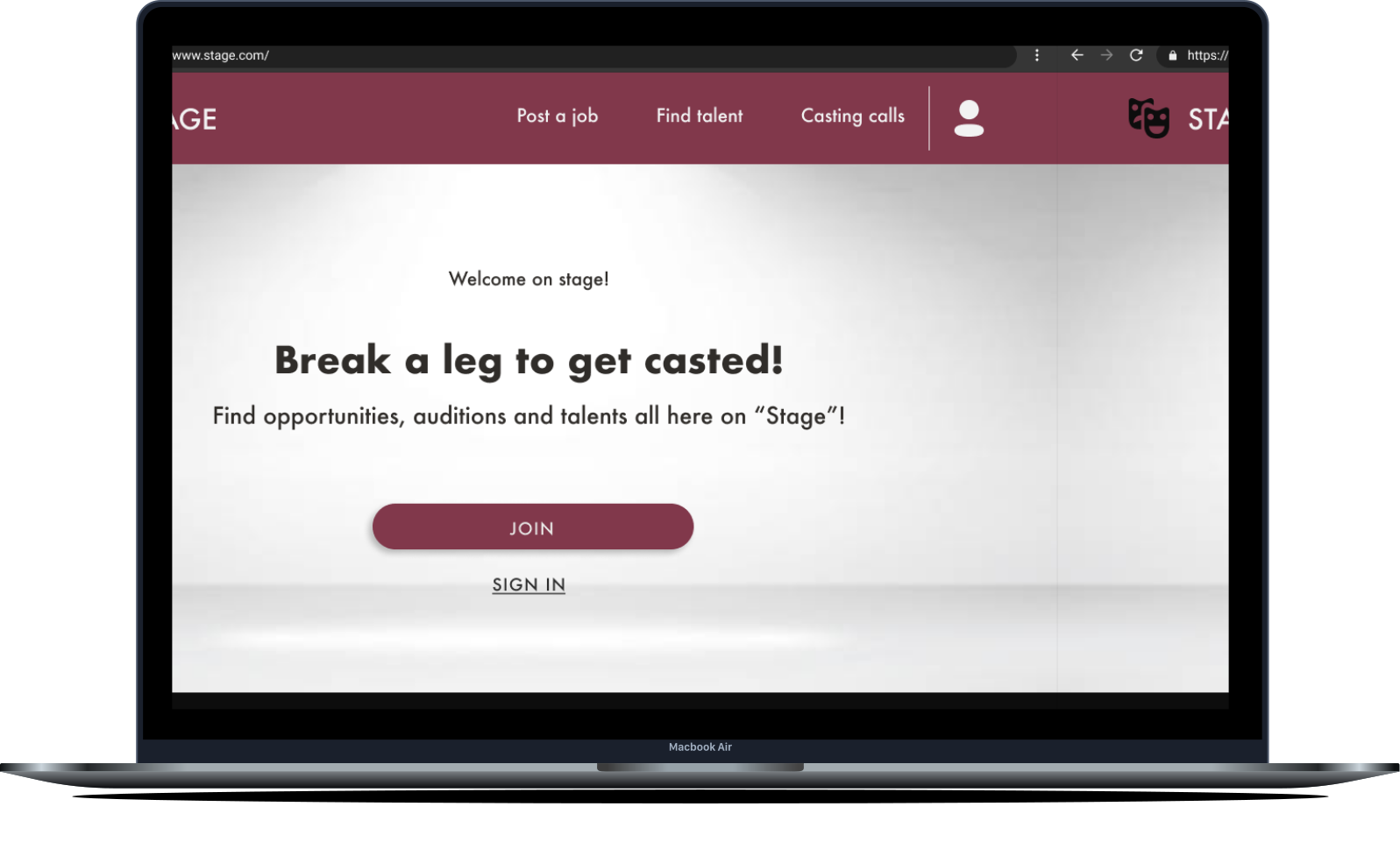
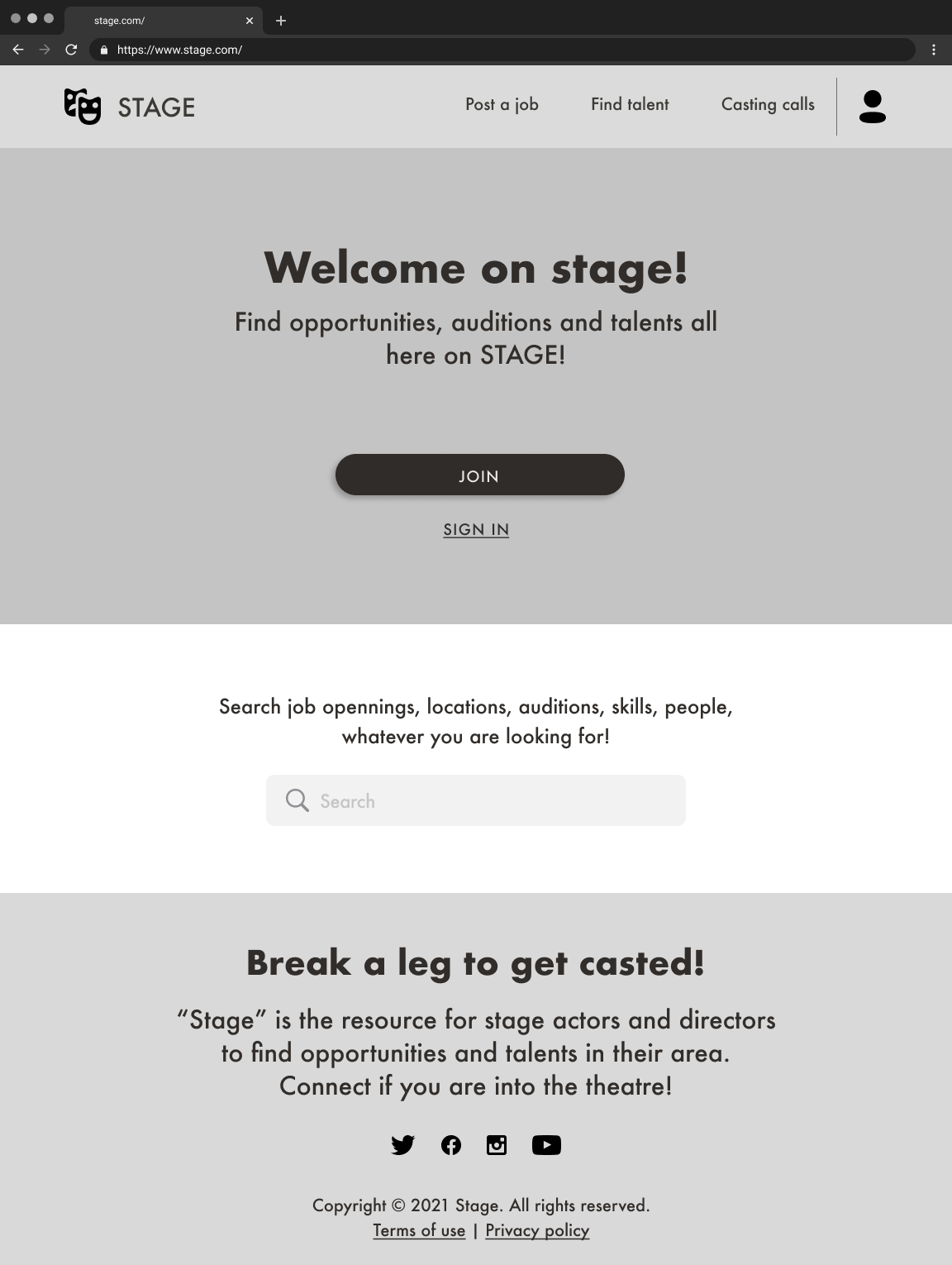
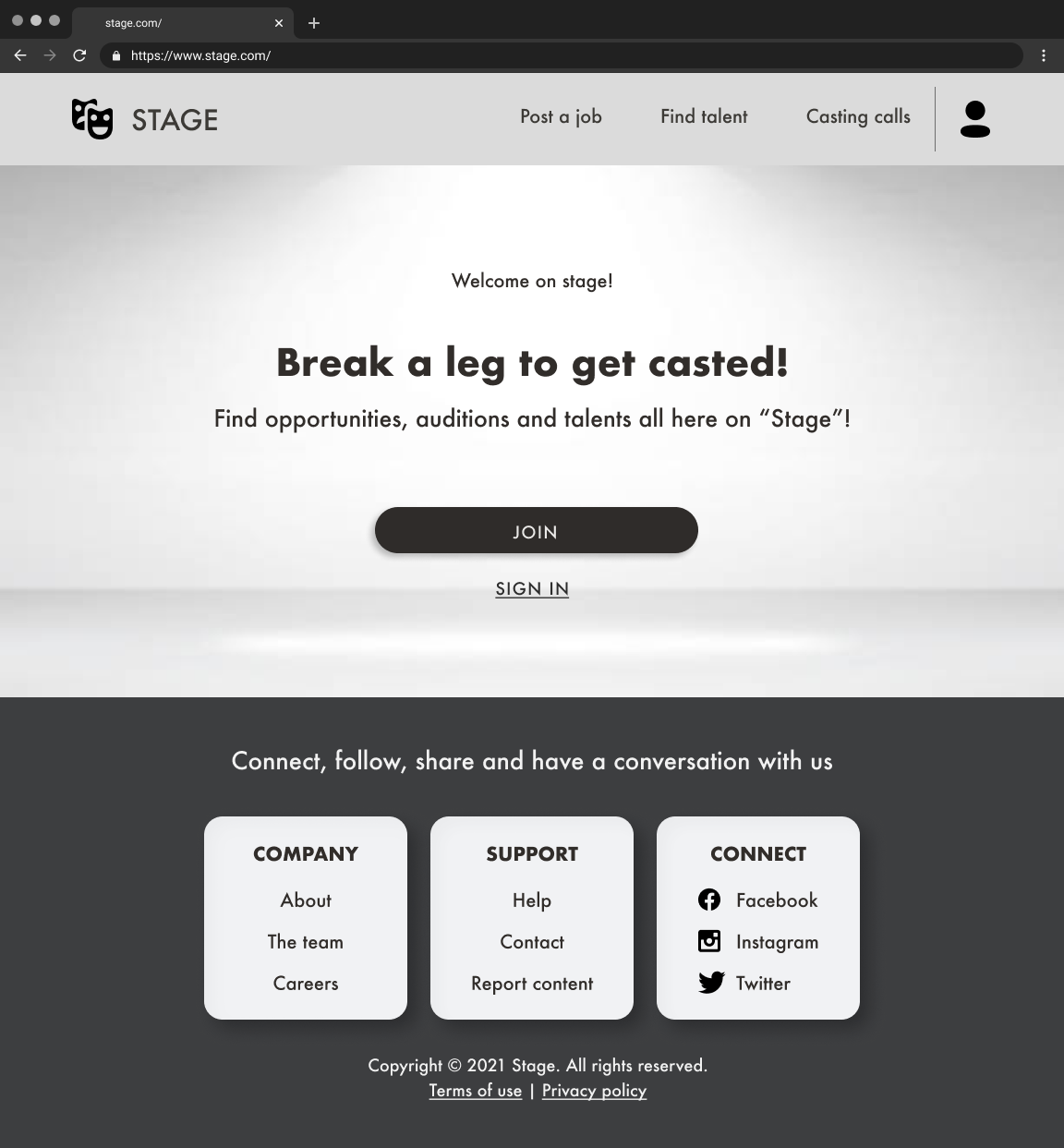
Sketches evolved into digital wireframes in Figma. Informal testing with two actors and two directors drove the refinements — for example, the home page moved from a bare search bar with an incomplete footer to a cleaner layout with organized, categorized footer content.
Results
Usability testing
I tested the prototype with ten local actors and two working directors over Zoom, focusing on navigation, profile creation, the clarity of the design, and search. The response was enthusiastic:
“I wish there was such a platform!”
Test participant
“It's so easy and clear to navigate through the website and filter the search!”
Test participant
Navigation and search filtering were the standouts, and the enthusiasm validated the product's demand. Testing also surfaced specific features to enhance in future iterations — the long-term success of a two-sided platform depends on sustained engagement from both actors and directors.
50%
of users want to be able to message right on the platform instead of emailing
25%
of users wanted a video call feature
Reflections
What I learned
Go deeper in interviews. A few more well-placed questions would have yielded richer insight. The quality of the research is only as good as the questions behind it.
Perfectionism is a barrier. Imperfect ideas are still worth exploring — chasing a perfect first version slows everything down.
Design sprints reward divergent thinking. A sprint reveals the merit in a wide range of ideas, even ones that aren't yet feasible to build.
Test earlier. Earlier testing cycles consistently improve the outcome — feedback is most valuable before decisions harden.

Next project
Let's find art! →